-
 Over the decades Heyen has most often thought, studied, and written about the Holocaust. His ground-breaking collection The Swastika Poems (Vanguard Press, 1977) was revised and expanded to Erika (1984). Thirteen more of these poems appear in Falling from Heaven (Time Being Books, 1991). Shoah Train collects more than seventy poems written over the last dozen years, lyrics of “discipline and honesty and courage and restraint,” as Archibald MacLeish described The Swastika Poems. Experiencing the new poems in Shoah Train, readers will find themselves in the voice-presence of one of our most important poets.
 -

-
 Silk Road is a collection of poems written in the persona of Donata Badoer, the wife of Marco Polo, who observes a newly connected world while attending to her everyday activities. In unbidden moments, she turns to perceive the economics and erotics of contact between the people of Europe and China, recognizing both tensions and camaraderie in their links across the globe.
 -
 “Blessed be sin if it teaches men shame,” wrote Georges Benanos. Sinnerman continues Michael Waters’ exploration of trespass as a mode of worship in poems that “delight in wit and wordplay” (The Gettysburg Review) and display “raucous devotion” while assuming “a divine erotic presence even in his more harrowing poems” (The Georgia Review). A fire escape, a fire hydrant, a father’s comb, the mosaic of a bull in an Italian shopping mall, a soul in flight—all assume resonance “that they may shine more darkly” in the light of Waters’ words. If sin is “seen as good once gone,” these poems weigh our attraction to transgression against our desire for forgiveness. Novelistic in depth and reach, elegiac in its embrace of the living and the dead, raw in its fraught vulnerability, and cunning in its explosive and tongue-delighting sound play, Sinnerman seems poised between the here-and-now and the invisible it invites and confronts.
 -
 What if music could bring about a revolution? What power might reside in such a musical work, and to what madness would its listeners be driven? A haunting tale of love, loss and obsession, Sixteen can also be read as a fascinating literary thriller revolving around the mystery of music. View all books from Etruscan Press by Auguste Corteau
 -
 Aurally rich, structurally varied and inventive, sensually textured, these are poems at once passionate and analytical, descriptive and meditative, lyrical and complex—poems that keep one eye on the moon while leveling their gaze at the self and its immediate world. With an alert nuanced intelligence, a sinuous flexible line, Moldaw’s poems turn swiftly and sharply, surprising us in their range and ease, their visionary core. While, in the quoted words of the painter Agnes Martin, “the mind knows what the eye has not seen,” Moldaw’s exact and sometimes challenging language bring eye and mind together, with revelatory transparency. A wild fire brings into focus her daughter’s unknown birth mother; a columbary outside the hospital window becomes a columbarium as she comes to terms with a friend’s dying of AIDS; tossing the I Ching coins affords the occasion for a long meditative sequence built on distilled moments; overheard piano music catalyzes a reverie of longing; Walter de Maria’s sculpture Lightning Field inspires a layered, penetrating rumination on art and life’s “multi-angled interrelationships.” Out of acutely observed, deeply felt particulars, Moldaw constructs poetry of imaginative daring that illuminates and transforms the life within us all, repeatedly achieving, to quote from The New Yorker, “lyric junctures of shivering beauty.”
 -

$17.00
Son of a Bird is a memoir in the tradition of Dorothy Allison and Flannery O’Connor. Surrounded by farm hands and wild, lush isolation, due to constant eye surgeries, the youngest of six children, Nin Andrews observes the world at a tilt. In this collection of prose poems, hunted by death and the brutalities of farm life, Andrews begins to connect the small black dots of her upbringing—her father’s relationships with men, her mother’s autism, and the burdens of childhood awakenings—ultimately cracking through the shadows that haunt her.Please note: you will be transferred to an outside website to make this purchase.
-
 Surrendering Oz is a memoir in essays that charts the emotional awakening of a bookish Bronx girl. From her early job as a proofreader at The Guinness Book of World Records through a series of dominating and liberating friendships and secret connections, the author takes charge of her life as a Texas professor, writer and wise student of her own soul. Reader’s Digest says reading Surrendering Oz “is like having a conversation with a bracingly honest but fundamentally kind friend. In 15 pitch-perfect essays, she chronicles her hard-earned rejection of the cultural fairytales of womanhood as she comes fully into possession of her life." Surrendering Oz was recently longlisted for the 2015 PEN/Diamondstein-Spielvogel Award for the Art of the Essay.
Awards
2015 Finalist – The Community of Literary Magazines and Presses Firecracker Award 2015 Finalist – Longlist PEN/Diamonstein-Spielvogel Award for the Art of the Essay
-
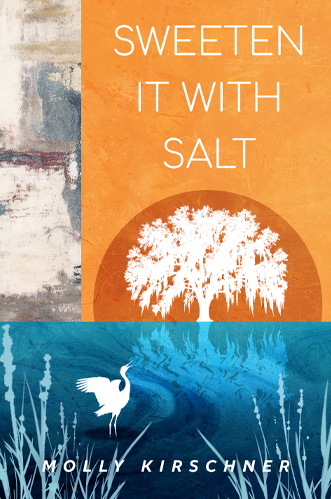
$18.00$16.78A luminous collection of poetry by Molly Kirschner that navigates the delicate intersection of the mundane and the metaphysical.
Set against backdrops ranging from the vibrant, storm-swept streets of New Orleans to the quiet, dusty corners of domestic life, these poems explore the "huge amoebas of time" that accrue in the spaces between our intentions and our reality.
With a voice that is both wryly comedic and deeply reverent, Sweeten It with Salt investigates the persistence of beauty amidst "unpardonable deeds," "stupid mistakes," and the "slow dance" of decay.
Whether she is playing "Sisyphus to a raisin" under a kitchen table, witnessing a "genderless god" in a Sikh temple, or contemplating the quantum entanglement of the soul, Kirschner consistently seeks the "nearest beautiful thing" and gives us a defiant and joyful act of mockery against the void.
Please note: you will be transferred to an outside website to make this purchase.
-
 The poems in Synergos smack of Whitman and Martí, two of Roberto Manzano’s most important influences; they outsoar anything pedestrian, even in celebrating the here and now and the close-to-hand. Translated by Steven Reese, the collection covers Manzano’s poetry from his earliest to his most recent work, which won the 2005 Nicolás Guillén Prize, one of Cuba’s highest awards. The text includes a substantial amount of interview material that clarifies Manzano’s poetics and places it within the traditions of recent Cuban poetry. Manzano’s writing offers a window into contemporary Cuban life in its attention to the local landscape and environment, an attention that won Manzano the 2007 Samuel Feijóo Prize for Poetry and the Environment. But its greatest achievement lies in making, from the local and everyday, a poetry that is unmistakably universal. “Manzano’s poems go beyond the traditionally circumscribed lyric, beyond the often humble and household range of so many contemporary poems. Translating those poems, and talking with Manzano about his work, was to experience that energy and ambition at close range, too close indeed to avoid being affected by it permanently Manzano offers one of the great gifts of translation—to be changed oneself in the process of that other, impossible change: moving a poem out of one language into another.”—Steven Reese, translator of Synergos
 -
 The Arsonist’s Song Has Nothing to Do with Fire, a highly compressed prose poem of a novel, explores the loneliness of three misfits as they attempt to reconnect to the modern world: Vivian, the wallflower who’s obsessed with death; Ronny, the arsonist, who’s resisting the urge to burn the whole town down, and The Doctor, who struggles to glorify his legacy with a brilliant and reckless vision: human flight.
 -

$19.00
A groundbreaking journey celebrating nature's diversity, family ties, and female power, and lamenting both our human and environmental losses. Maurya Simon's twelfth volume of poems, The Blue Bridge, is a literary tour de force that bears witness to the twenty-first century's dire and lasting dangers brought about by human folly and greed. At the same time that it laments species loss, it honors the enduring lives of small creatures, and the perseverance and adaptability of larger animals. Simon also charts the journey of her own life in an America that is increasingly marked by violence and division, as well as by the ameliorating and lasting ties between people. At turns philosophical, playful, irreverent, and passionate, this book showcases a poet's work at the peak of her powers, as she illuminates how the bonds between spirit and flesh, and each other, sustain us.Please note: you will be transferred to an outside website to make this purchase.
-
 When Isidore Mirsky’s sister-in-law Joan loses her apartment, she moves in. Mirsky’s world is already in flux—his job lost, his bayside town under siege by developers—and now he must struggle with his bewildering attraction to Joan, who evokes for him all the qualities that once drew him to his wife. How can a warm, unpredictable man remain true to himself and to the woman he loves? Desire, and the renewal it brings, might just be the thing that causes damage. Outrageous, tender, and alive with the sound of Isidore’s voice, The Burning House captures a man at his most vulnerable moment, on the brink of something new. "A vigorous, interior-driven narrative... Lisicky is a beautiful and powerful writer; his prose has a palpable energy that demands close attention...."—Publishers Weekly "An extraordinary fiction in that it sustains a believable poetic voice throughout... Lisicky's longer prose piece...often feels like a long, beautiful narrative poem about what it is to be flawed and human in a world that often seems, at best, indifferent."—The Boston Globe “Paul Lisicky’s The Burning House smolders with muscular, beautiful language, and shines with love for two sisters as each blossoms darkly into her own future. Lisicky’s odd man out finds his way deeply inside the reader’s desires and hopes. The answer to the question, ‘what do (good) men want?’ may well be answered in this elliptical, pitch-perfect gem of a novel.” — Jayne Anne Phillips
 -
 For this book collection, the author has selected about 150 poems from eight previous books, and concludes with a new collection of 46 poems. In the face of such obscenity that stains our 20th century, how is it possible that we might stay sane, might honor the innocent victims of unspeakable horror, might remember, and might even dare to attempt to compose poetry despite Theodor Adorno’s injunction that after Auschwitz only a barbarian would write it. The author comments about this collection: “I suppose that The Candle is the record of my attempt to come to grips with Elie Wiesel’s reminder: ‘If you have not grasped it until now, it is time you did: Auschwitz signifies death — total, absolute death — of man and of mankind, of reason and of the heart, of language and of the senses. Auschwitz is the death of time, the end of creation; its mystery is doomed to stay whole, inviolate.’”
 -
 In this book of voices, speakers resurrected from the deeper past and the dead chafe against the circumstances of love, sex, loss, and longing. The Casanova Chronicles & Other Poems includes forty sonnets, each written in a relaxed meter. Each sonnet is a persona poem, told from the point-of-view of a real-life character. In The Ballard Sonnets those characters include Alba Ballard, her husband, her son, and two of her pet parrots, all of them dealing with the effects of her death. "In this wild, sexy, exuberantly off-the-wall collection, parrots, puppets, and the great Casanova take turns force-feeding Viagra to the stuffy old sonnet. But it's Myrna Stone's Rabelaisian gift for language that really steals the show. My head's still spinning."—George Bilgere
