|
Authorship
can be tricky. Intimate and personal, it forges a contract between
utterance and sign. It is the signature of purpose. It gives heartbeat a
page count. Yet, authorship is vagrant and provisional. It disdains
age, change of heart, or death. Authorship can be paradoxical, as in
Anonymous; fraught, as in the Bible; faked, as in Ossian; or contested,
as in Shakespeare. Maybe authorship isn’t a real ship at all, only a
Homeric clash of arms. Yet, there is the codex with all accoutrements:
title, blurbs, launch, reviews, and sequels. Post-Gutenberg, the
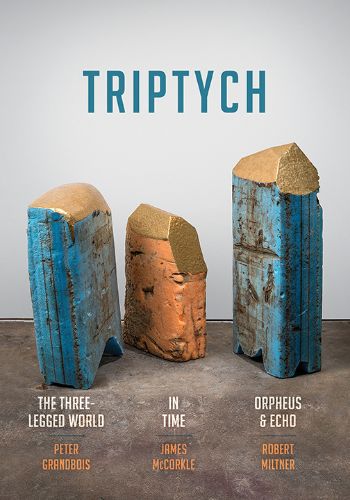
singular mark of authorship is the book. Triptych disrupts conventions of book authorship.
Between two covers are three books: The Three-Legged World by Peter Grandbois, In Time by James McCorkle, and Orpheus & Echo
by Robert Miltner. They are bound by no prior agreement or
collaboration. There is no aesthetic reason for the order (alphabetical
by...wait for it...author!). Triptych is not the product of a contest, program, solicitation, or advertisement; it has no precedent with this publisher.
Triptych is not a means to package verse. It is not a selection
or sampler. It is not a special issue. Peter Grandbois and James
McCorkle are veteran Etruscans, and Robert Miltner is a valued
colleague; but these authors had not colluded, discussed, or even met.
Their books crossed the transom independently from diverse parts. Of
course, books converse with other books, and poetry, rippling from
unmeasured sound into rampant forms, is especially polyphonic.
“Poetry’s roots lie in the communal,” Peter Grandbois writes in his assessment of Triptych. “The first sceops,
or shapers of words, recited their poems to an audience gathered about
the fire, and later the mead hall, one poet beginning where the previous
ended. Only recently has poetry shifted to an isolated activity written
by a solitary writer and read by a lone reader. Hwaet! The communal origins of poetry have returned in Triptych!
What a great joy to share this space with two poets whose mythological
hauntings and metaphysical—musings dance so tantalizingly with my own.
Buy a book. Take a seat, and welcome back to the hearth!”
A paean to a life never lived and the many selves that haunt us, Grandbois’ The Three-Legged World
begins: “I wake and I am/ an unkowing” giving voice to the notion that
the very act of being is a separation, an untying not just from the
world but from everything we thought we knew.
Peter Grandbois is the author of nine previous books, the most recent of which is Kissing the Lobster
(Spuyten Duyvil.) His poems, stories, and essays have appeared in over
one hundred journals. His plays have been performed in St. Louis,
Columbus, Los Angeles, and New York. He is a senior editor at Boulevard and teaches at Denison University in Ohio. You can find him at www.petergrandbois.com.
“In these three distinct, discrete, and demanding collections within a
single cover, what connects them all is the attention to the celebrant’s
voice,” James McCorkle says of Triptych. He continues: “If
poetry is anything it is the pleasure of the poet in their
language—whatever the poem may mean is ancillary to the velocities of
language, the inhabitations that language creates, formal or densely
scattering, historical or local. Each of these collections offer readers
a dwelling in language, the extension of voice across poems and into
poetry-making / poiesis / formations. These are individual
formations and velocities, yet as the collections become proximate, they
are near to each other, sharing the pleasures of this work, this
in/forming.”
These poems torque and jar, leave perceptions open, then coalesce into
what is, perhaps at the liminal moment of sonic and sighted
disappearance or at the moment of a dangerous transcendence. “Geography
is song,” McCorkle writes in “Fox-Sparrow”… moments of revelation are
not privileged rather the duration of soundings that distinguish these
poems.
Born in St. Petersburg, Florida, James McCorkle is the author of Evidences (selected by Jorie Graham for the 2003 APR-Honickman First Book Award) and The Subtle Bodies
(Etruscan Press 2014). He received an M.F.A. and Ph.D. from the
University of Iowa and is a recipient of fellowships from Ingram Merrill
and the NEA, he teaches at Hobart and William Smith Colleges in Geneva,
New York.
“The poets in Triptych are experimenting with poetry’s innovative possibilities and unexpected potential,” Robert Miltner writes. “Peter Grandbois’ The Three-Legged World offers lyric meditations on stance, speech, and sonority. James McCorkle’s In Time computer code-like lines explore the relationship between breath and line breaks. Robert Miltner’s Orpheus & Echo evokes fragments of lost texts that straddle the intimate distance between the prosaic and the poetic. Reading Triptych, a unique three-books-in-one collection, is like attending a seminar on twenty-first century poetics.”
Orpheus & Echo is a prosodically mysterious prose poetry
collection re-envisioning the Orpheus and Eurydice story across time and
space (Greek islands, recording studios, Las Vegas). Exploring the
intersections between music and poetry, this collection mourns loss and
celebrates rediscovering one’s muse through the timelessness of art,
song, and poetry.
Robert Miltner’s prose poetry collection is Hotel Utopia (New Rivers Press), winner of the Many Voices Project poetry prize; his prose poetry chapbooks include Against the Simple (Kent State University Press), winner of a Wick Chapbook award, and Eurydice Rising (Red Berry Editions), winner of the Summer Chapbook award; his book of brief fiction is And Your Bird Can Sing
(Bottom Dog Press). A recipient of an Ohio Arts Council award in
poetry, he has been a finalist for the National Poetry Series, the
Louise Bogan Award for Artistic Merit and Excellence, and the New York
Center for the Book chapbook prize. An Emeritus Professor of English at
Kent State University and the Northeast Ohio M.F.A. in Creative Writing
(NEOMFA), Miltner edits The Raymond Carver Review. He lives in the historic Vassar Park neighborhood in Canton, Ohio, with his wife, the writer Molly Fuller.
Etruscan brings these three books together because they exerted upon our
editors a gravitational pull, causing the shadow of one to fall across
the reading of another. When Grandbois, McCorkle, and Miltner were
invited to read each other’s books, they sensed the congruence, and
embraced the venture enthusiastically. In fact, without conspiring
toward a collaboration which was not conceived, each poet seemed to have
augured the triad. Triptych launches no school. It backs no
cause. What these books share is not easily labeled. None follows
narrative conventions. None dwells on confession. None abides
predictable meter. None is easily parsed. Each climbs eerie heights
where ego finds no purchase. Each takes a kaleidoscopic view of
selfhood.
Triptych will be available from Etruscan Press in May of 2020.
|