|
|
|
|
|
“My mother
owned this dictionary for decades before I ever knew about it,” she
says. “She had packed it away in a chest with a bunch of her father’s
belongings long ago and forgotten it was there." - Karen Donovan
|
|
On the Power and Magic of Words: An Interview With Karen Donovan
|
|
|
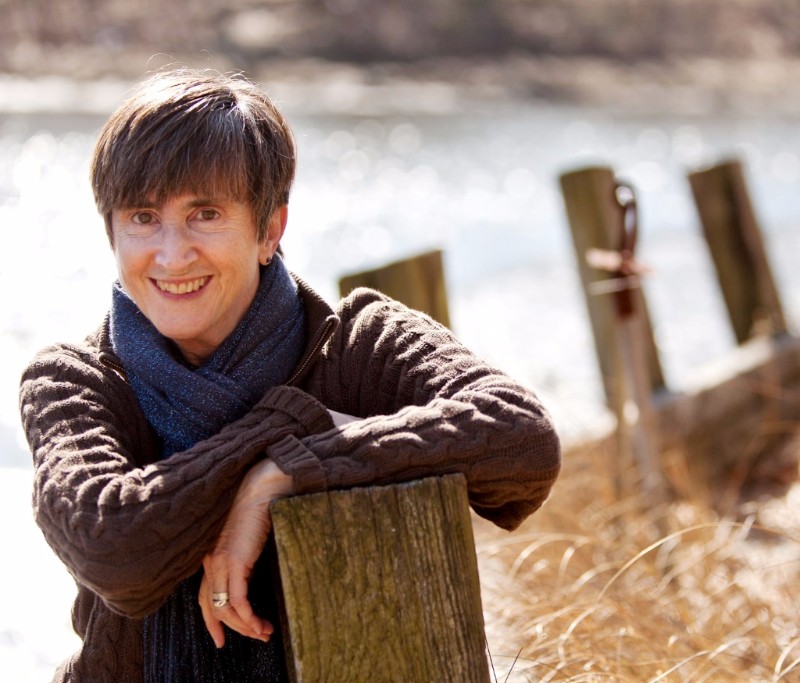
A 1925 Webster’s New International Dictionary of the English Language that once belonged to her grandfather became the inspiration for Karen Donovan’s forthcoming Aard-vark to Axolotl
(Etruscan Press, 2018). It is an eclectic series of tiny stories and
prose poems, based on a set of illustrations from the pages of that very
dictionary. She collected pictures of plants and animals, diagrams and
devices, and created a new narrative for each one. The charming result
of her effort is an assortment of small poetic stories that work on the
reader like alternative definitions for items drawn from a cabinet of
curiosities.
How did Donovan come to be in possession of her grandfather’s
dictionary? “My mother owned this dictionary for decades before I ever
knew about it,” she says. “She had packed it away in a chest with a
bunch of her father’s belongings long ago and forgotten it was there.
One day she showed up at a family gathering with it in her arms and said
to my husband, Walker, ‘Here, you like books.’ I think it amused her to
unload this gigantic dictionary on him and see what he would do. Of
course, he was delighted because she was right. He does like books. We
trucked it home and immediately set it up on a bookstand.”
And that’s where the dictionary lives now. “It’s a venerable presence in
a house full of books,” Donovan says. “Picture a very small cottage
perched on the edge of a tidal marsh off a small cove of Narragansett
Bay. Inside the house, you can pretty much get anywhere you need to go
in a few steps. It’s really more of a boat than a house. The walls are
covered with art, and the ratio of books to total square footage is
considerable, so visitors don’t have much chance of noticing the
dictionary per se right away. Once you see the darn thing on the
bookstand in all its tonnage, though, there is a definite wow factor.
The digital generation can’t quite believe it exists.”
Although she lives in a house full of books, she wouldn’t consider a
love of books necessarily runs in her family. “To wit, my mother’s
relief that we agreed to take the dictionary off her hands,” says
Donovan. “But my lifelong practice of book hoarding has made up for any
lost ground. It’s lucky that I turned out to be a poet, because you can
easily fit four or five books of poems on a shelf in the same space a
novel would occupy. That works out great.”
But there’s more to the story behind Aard-vark to Axolotl than
meets the eye. Sure, it’s a fun and fascinating read, full of wit and
whimsy and clever observations on life. But Donovan’s connection to her
grandfather, to whom she dedicates this book, goes far beyond being
captivated by the pictures in his old dictionary. She says, “I knew my
grandfather Raymond as a gentle, soft-spoken man who taught me how to
play chess and died when I was ten years old. Not until much later did I
learn about his awful drinking problem and then finally understood why
he did not live with my grandmother and why my mother was mad at him a
lot.”
She goes on to describe a bookplate pasted on the flyleaf of the
dictionary. “It reads ‘The R. H. Burton Estate Service, established
1921.’ It gives his office address in downtown Providence in the
Industrial Bank Building, an iconic feature of the city skyline that
everybody calls the Superman Building. An old leather bookmark is still
stuck in at the start of the ‘O’ section. For me,” she says, “the
dictionary is a token of the real man behind the disease. He managed to
have a life before everything fell apart on him, and this dictionary
tells me he would have been thoughtful with language—that he cared about
words.”
It’s obvious this attention to the details of language and words was
passed along. Not only is Donovan the author of two prior volumes of
poetry, Your Enzymes Are Calling the Ancients (Persea Books, 2016) and Fugitive Red
(University of Massachusetts Press, 1999), but for 20 years she and her
husband co-edited a literary journal of short prose called ¶: A Magazine of Paragraphs. It
was a true labor of love. “We published ¶ from 1985 to 2005,” she says.
“From the beginning, it was a tremendous amount of arduous, painstaking
work and a total blast. We did our entire run of 25 issues before the
Internet struck. Everything was paper. Piles and piles of submissions
coming in the mail from everywhere, following us doggedly through three
states and five changes of address. One day the postman asked me, ‘What
is it you guys do again?’”
Donovan especially loved reading submissions. “Once the box of envelopes
reached a certain unmanageable height, we would call time and spend a
weekend reading,” she says. “The magic was that you never knew what
might be in the envelope. When all you ask for is paragraphs of 250
words or less, you can get some wondrously berserk and idiosyncratic
voices. The concept behind ¶ was homeopathic. Many small doses of
reality in very short form, perfectly sized to fit in the back pocket of
your jeans. We assembled each issue, printed only 400 copies, and sent
them out as an antidote to the world’s ills.”
Donovan has continued this thread with Aard-vark to Axolotl. Her
quirky images and definitions may not be the solution to the problems
of our world, but they certainly are a welcome distraction and sure to
cure what ails you.
Pamela Turchin is pursuing her M.F.A in fiction from Wilkes
University, where she serves as a graduate assistant and as the
production editor at Etruscan Press.
|
|
New Releases from Etruscan
|
|
|
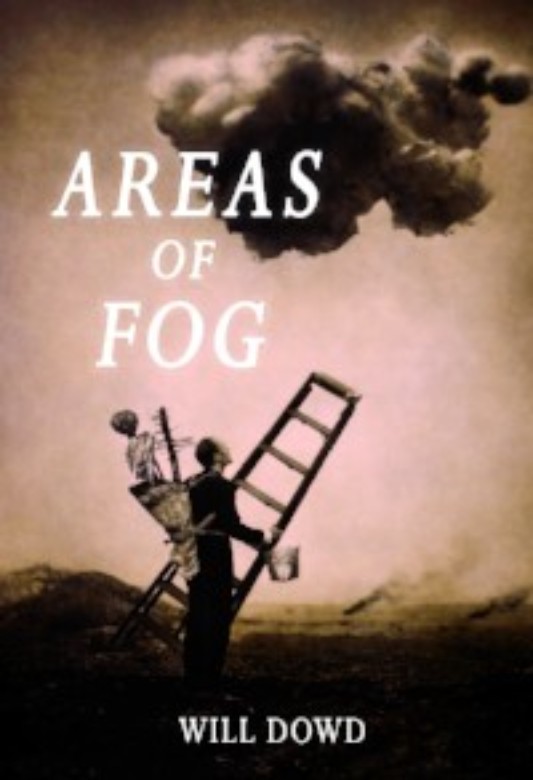
We’re proud to welcome Will Dowd’s Areas of Fog to the Etruscan Press family.
Areas of Fog is a collection of lyric essays recording one year of New England weather.
Each essay opens with a weather report, combining wit, humor, and poetry
taking readers on a journey through themes of solitude, madness, and
the nature of happiness. Paul Mariani, author of The Whole Harmonium and Epitaphs for the Journey, says,
“Will Dowd guides us through the seasons, describing with a mastery of
language what no weatherman I know even comes close to describing. Here
in these pages we can delight in the sea-changing weather of a mind
ranging from the autobiographical to a kaleidoscope of literary
allusions which–far from dragging us down–lift us with the flair and
insight only a poet can offer us.”
|
|
|
|
|
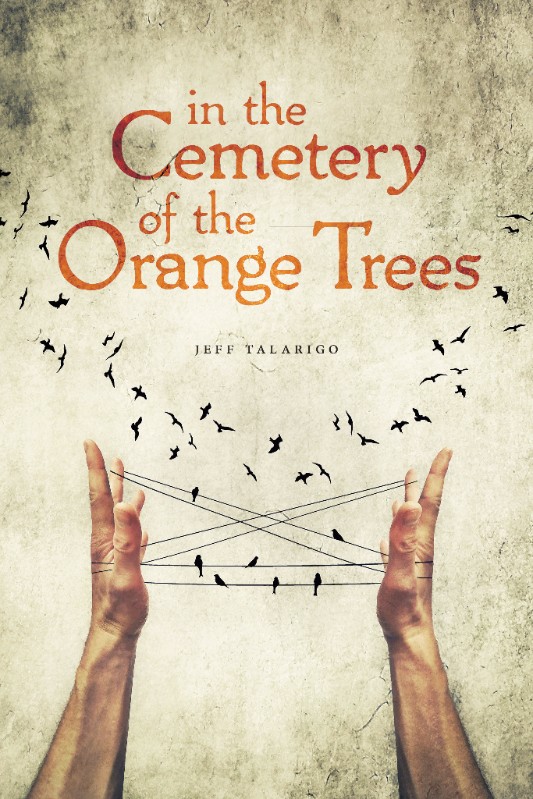
In the Cemetery of the Orange Trees by Jeff Talarigo
We’re also proud to welcome Jeff Talarigo and his novel In the Cemetery of the Orange Trees to the Etruscan Press Family.
In late 1948, Ghassan is threatened by two talking jackals. If he
doesn’t paint the signs of the newly named villages and towns, his wife
will give birth to a goat. Thus begins the exile to Gaza of Ghassan and
his goat.
In the Cemetery of the Orange Trees presents the history of
Gaza told as never before: through the eyes of a night guardian of a
talking goat; a carrier pigeon that befriends a young boy who sells
photos of martyrs; a refugee who eats books and then recites them word
for word; a Palestinian father who sneaks animals into Gaza through a
labyrinth of tunnels; a talking sheep who is caged in the Gaza Zoo. In the Cemetery of the Orange Trees is a disquieting allegory of the clash between the powerful and the silenced. Colum McCann, author of Thirteen Ways of Looking,
says, “As much a book of poetry as a novel, as much a symphony as a
memoir, this is an extraordinary book from a writer at the top of his
powers. Reminiscent of Berger and Calvino, Jeff Talarigo manages
to capture the breadth and circumference of story-telling, while also
giving us a privileged insight into the daily life and dreams of Gaza.”
|
|
|
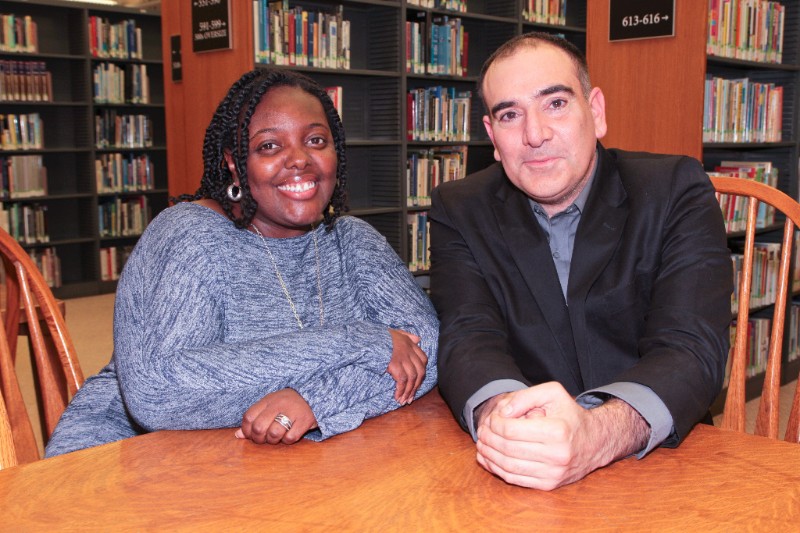
Remica Bingham-Risher, author of What We Ask of Flesh, and
Aaron Poochigian, author of Mr. Either/Or, visited five schools and
taught at both men and women's prison classes while in Youngstown,
OH.
|
|
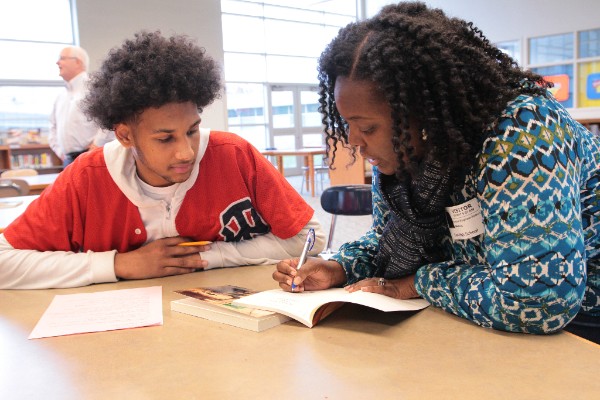
From November 13 to 16, Remica Bingham-Risher, author of What We Ask of Flesh, and Aaron Poochigian, author of Mr. Either/Or,
visited Youngstown, OH as part of a four-day outreach program sponsored
by The YSU Poetry Center and Etruscan Press. The outreach program
brings acclaimed authors to work with under-served students in area high
schools, as well as incarcerated citizens, increasing the literacy of
the students and offering a general appreciation for the literary arts.
Bingham-Risher and Poochigian were both excited to participate in
Etruscan’s outreach program to help foster a literary community within
the Youngstown area. Bingham-Risher says, “I'd participated a few
years ago when What We Ask of Flesh was released. I
loved my experience then, so I came back when Phil [Brady, Etruscan
Press Executive Director] invited me. Working with Aaron Poochigian
this time around was fantastic. We developed a real rapport, that I
think the students all felt.”
|
|
|
|
"Some of the students seemed
hungry for more experiences like this ... I think this points to
the fact that some are always looking for validation for their art,
encouragement, and tangible evidence that it is possible to do something
they are passionate about and make a living at it," Bingham-Risher
said.
|
|
Poochigian says, “I was excited to
participate in Etruscan’s Outreach Program because it fits in perfectly
with my broader #SavePoetry campaign. This campaign treats poetry as an
endangered species—endangered because, however many people might be
writing it, very, very few read it outside of classroom assignments. To
build on the analogy, while I am grateful for the “preserves” of
colleges and universities, I want to release poetry “back into the wild”
by making it a part of daily life…I imagine an America in which people
quote poetry in everyday conversations and where it is just as common to
see someone reading poetry on a city bus as listening to music on
headphones.”
During Bingham-Risher and Poochigian’s stay in Youngstown, they visited
Austintown Fitch High School, Chaney High School, Choffin Career &
Technical Center, East High School, Youngstown Early College, and taught
both at men and women’s prison classes. Poochigian, a classics scholar
as well as a poet, also visited Dr. John Sarkissian’s YSU Classics
seminar. Students at all the schools and in both prison classes received
copies of What We Ask of Flesh and Mr. Either/Or and a
study guide that corresponded with each book. At Chaney High School,
Bingham-Risher and Poochigian awarded a cash prize for a one-page
writing contest. Winners were presented with an Etruscan Press tote bag
containing Etruscan titles, while honorable mentions were awarded Barnes
& Noble gift cards.
|
|
|
|
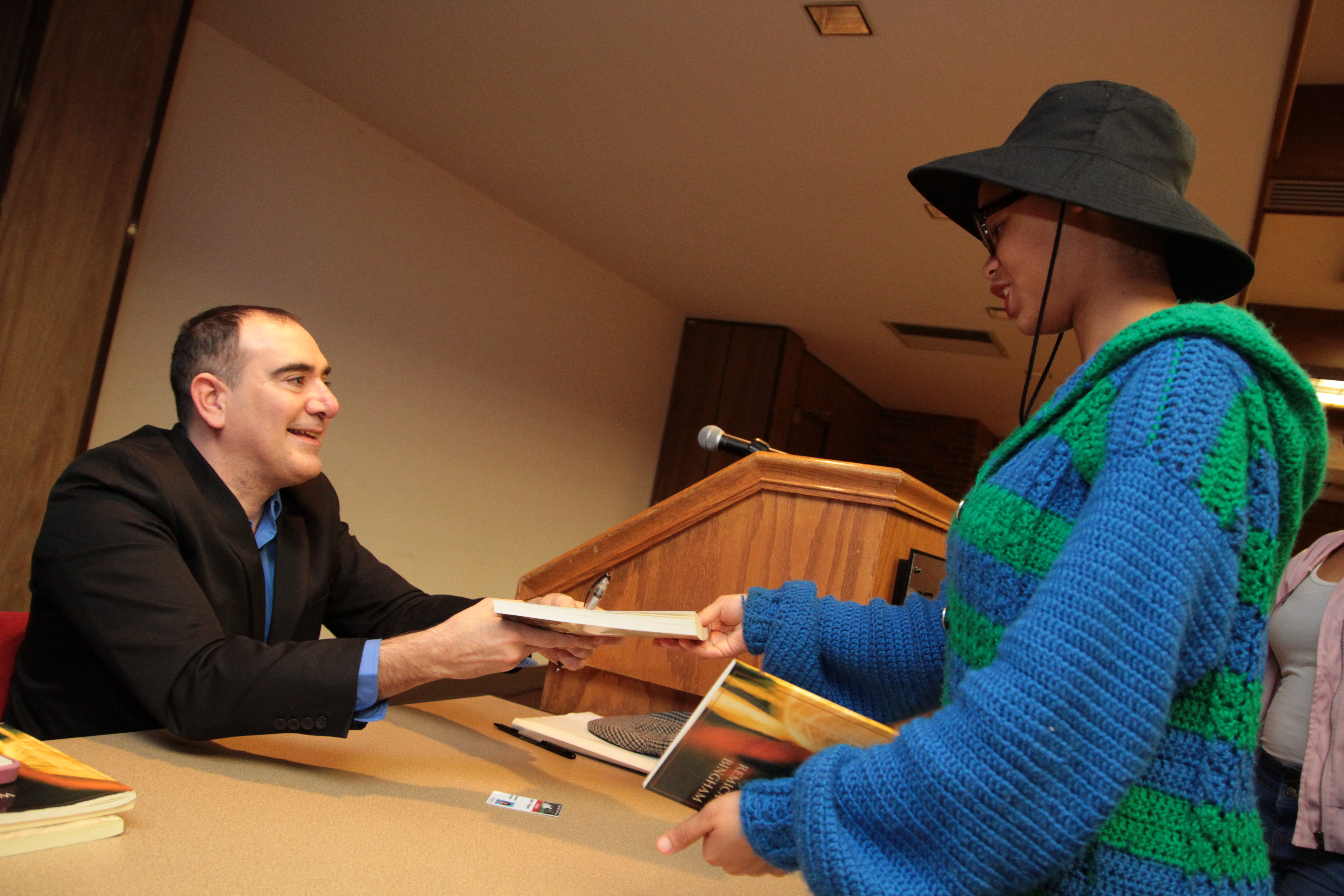
"I
want to release poetry “back into the wild” by making it a part of
daily life…I imagine an America in which people quote poetry in everyday
conversations and where it is just as common to see someone reading
poetry on a city bus as listening to music on headphones,” Poochigian
says.
|
|
Bingham-Risher and Poochigian also
participated in one joint public reading during their stay in
Youngstown, held at the Youngstown Public Library and co-sponsored by
the friends of the Public Library of Youngstown and Mahoning Valley and
Etruscan Press. Bingham-Risher also participated in two other public
readings during her time in Ohio: the Youngstown YWCA featured both a
reading and a discussion, and the ACTION Clergy Caucus Fellowship
Breakfast in the Newport Library. (ACTION stands for Alliance for
Congregational Transformation Influencing Our Neighborhoods, which
focuses on a range of social issues, including crime prevention,
education, immigration, and health and wellness.) Following her
reading, Bingham-Risher signed copies of What We Ask of Flesh for the community.
Of her time in Youngstown, Bingham-Risher said, “Some of the students
seemed hungry for more experiences like this: many stayed after and
asked us questions upon question about our life and work; some wanted
selfies with us and others asked for email addresses so they could share
their own work and get feedback. I think this points to the fact that
some are always looking for validation for their art, encouragement, and
tangible evidence that it is possible to do something they are
passionate about and make a living at it. Knowing this early on would
have surely been a great gift to me. Because of all this, I think the
Etruscan Press/YSU Outreach Program is invaluable.”
Poochigian was also impacted by his time in Youngstown. He says, “I was
most affected by my conversation with the male inmates in a correctional
facility. They became comfortable enough with me to share poems they
had written. One poignant poem, “My Weekend Off,” expressed an
All-American desire to be home with family on the weekend, go fishing
and build furniture in a garage workshop. Another described a prison
religious conversion through a whispered conversation from cell to
cell.”
For more information about the Etruscan Press/ Youngstown State University Poetry Center outreach program, please visit our website.
|
|
|
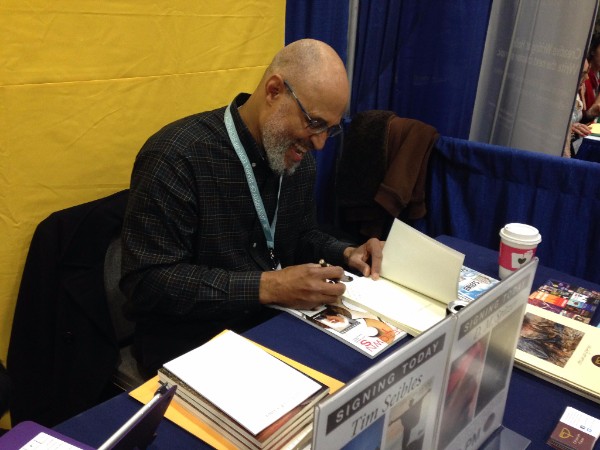
Tim Seibles(Fast Animal and One Turn Around the Sun) signed books at AWP17.
|
|
Etruscan Press is once again exhibiting at the Association of Writers and Writing Programs Conference (AWP), which will be held in Tampa, FL from March 7-10, 2018. Partnering with the Maslow Family Graduate Program in Creative Writing at Wilkes University,
Etruscan will host author signings during the Bookfair in booth
(1202). For more information about our book signings, panels, and
readings, please visit our website.
We can't wait to see you there!
|
|
About Etruscan Press:
Housed at Wilkes University and partnering with Youngstown State
University, Etruscan is a non-profit literary press working to produce
and promote books that nurture the dialogue among genres, cultures, and
voices.
For the latest Etruscan events, please visit our website.
|
|
|
|
|
|
|
|
|