|
|
|
|
Approaching All Art With Unchecked Enthusiasm: An Interview With Dante Di Stefano
by Pamela Turchin
|
|
|
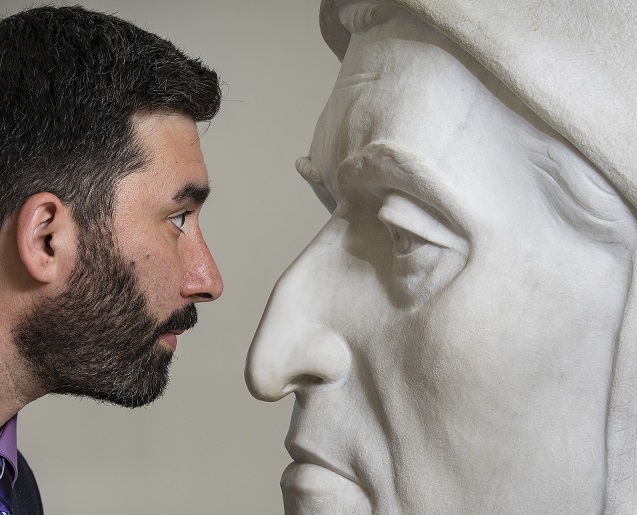
Dante
Di Stefano always knew he wanted to write: he loved reading and
listening to stories; as a kid, he read the dictionary daily and drew
comic strips, wrote stories, and weekly letters to his grandparents from
fourth grade until the end of ninth grade; he kept a journal throughout
adolescence. He says, “My mother was a prolific reader; she read
everything from the Bible to romance novels; she might finish a novel by
Thomas Mann and start one by Danielle Steele. My grandmother and great
grandmother were accomplished storytellers; I loved learning family lore
from them and hearing about Binghamton, New York in the first half of
the twentieth century. In high school, I read all of the Russians I
could find: Gogol, Dostoyevsky, Turgenev, Tolstoy, Bulgakov, Lermontov. I
also read Kafka, Melville, and Conrad extensively. I wanted to be a
novelist.”
When Di Stefano was nineteen, he read “Howl” by Allen Ginsberg, “The
Wreck of the Deutschland” by Gerard Manley Hopkins, and Stephen
Mitchell’s translation of Rainer Maria Rilke’s “Archaic Torso of
Apollo.” He knew then there was no question about what he would do with
the rest of his life. He devoted himself to loving and reading poetry:
“Writing poetry became a means to understand poetry in all of its
mystery, contradictions, and terrible beauty. For me, the act of writing
poetry remains a form of critical engagement with, a love letter to,
the art I admire.”
Literary citizenship is a term we often hear; Di Stefano has valuable words on this subject: “E.M. Forster begins Howard’s End
with perhaps the greatest epigraph in all of literature: ‘Only
connect.’ Those two words embody the categorical imperative binding
together all great literature. As readers and writers, we are about the
business of deep listening, sustained attention, lasting connection
forged by empathy. Being a good literary citizen is an extension of the
shared vocation of all writers; it’s about remaining radically open to
the work of others and championing that work in any way we can. Good
literary citizens create opportunities for other writers to be heard and
read. All writers do this in one way or another. There are as many
different ways to be a good literary citizen as there are different
writers. Solipsism is the death of good writing, and being an active
literary citizen provides one antidote to the many diseases of
egocentrism one must guard against as an artist.”
Some ways to be a good literary citizen according to Di Stefano include:
writing book reviews; editing an anthology; volunteering for a literary
journal, website, or press; starting a journal or website; buying books
and donating to presses and journals, if you can afford to; running a
reading series; going to readings you are not involved in; providing
community workshops; if you teach, being kind to your students; being
gracious to writers you read with or correspond with; writing reviews on
Amazon and Goodreads, even if it’s just giving the book five stars and a
single word of praise; using social media to uplift the work of others;
writing blurbs; creating panel proposals for and attending conferences
to meet and appreciate other writers, and acknowledging publicly the
people who have helped you in your writing life. Good literary
citizenship could be as simple as sending someone a note of
encouragement when you read something they’ve written, even if you don’t
know them personally.
He also believes it’s important not to be aesthetically defensive:
“Instead of judging someone’s work based on a comparison with your own,
it’s better to try to understand it on its own terms. I try never to
dismiss a poem I don’t fully understand, even if my first impulse pushes
me to do so. Reading and promoting work that is vastly (formally,
thematically) different from your own is probably the most rewarding
form of good literary citizenship. There is so much interesting work
being done in small presses and journals. Seeking out and heralding this
work is immensely satisfying. Some of the presses I’ve been admiring
for the past few years include: Augury Books, Backbone Press, Canarium
Books, Fathom Books, Glass Poetry Press, and Orison Books. I’ve also
been impressed by the wide variety of writers and books that Etruscan
Press publishes. Think about how distinct Robert Eastwood’s Romer is from Karen Donovan’s Aard-vark to Axolotl: Pictures from My Grandfather’s Dictionary, to name two recent examples.
Lastly, for me, being a good literary citizen involves doing things for
others without expecting reciprocity. I don’t keep score or expect a
quid pro quo relationship with other writers. I choose to remain
grateful and excited and appreciate every time a writer or editor has
gone out of their way for me. I engage and promote the work of other
writers because I love it. As William Blake tells us, ‘Exuberance is
Beauty.’ The approach to all art should be unchecked enthusiasm.”
Giving back is vital for authors and small presses. Di Stefano understands this: “To paraphrase Lewis Hyde’s excellent book, The Gift: Imagination and the Erotic Life of Property,
literature, and especially poetry, exists in a gift economy. In the
market economy, a book of poetry is mostly non-remunerative for the
author and for the press that publishes it. A book is a gift, and the
giving of the gift necessitates an exchange. There are multiple
exchanges of this kind in the publication process. If there is a
currency underwriting these exchanges it is attention, but that currency
is not as significant as the exchange itself. It’s a gift to create,
it’s a gift to be published, and it’s a gift to read and to be read.
Giving back to small presses is essential because they operate on such
slim margins and without them the world would be a much poorer place.
Giving back to other authors is vital because we have such a fleeting
interval to spend on earth, and so, why not foreground praise and
encourage excellence? Or again, as Blake reminds us: ‘And we are put on
earth a little space, / That we may learn to bear the beams of love.’”
Dante Di Stefano is the author of Ill Angels and Love Is a Stone Endlessly in Flight. His poetry, essays, and reviews have appeared in American Life in Poetry, Best American Poetry 2018, Poem-a-Day, Prairie Schooner, and elsewhere. Along with María Isabel Álvarez, he co-edited the anthology Misrepresented People: Poetic Responses to Trump’s America. He holds a PhD in English Literature from Binghamton University.
Pamela Turchin earned a M.A. and M.F.A. in fiction from the Maslow Graduate Creative Writing Program at Wilkes University, where she serves as the production editor for Etruscan Press.
|
|
New Releases from Etruscan
|
|
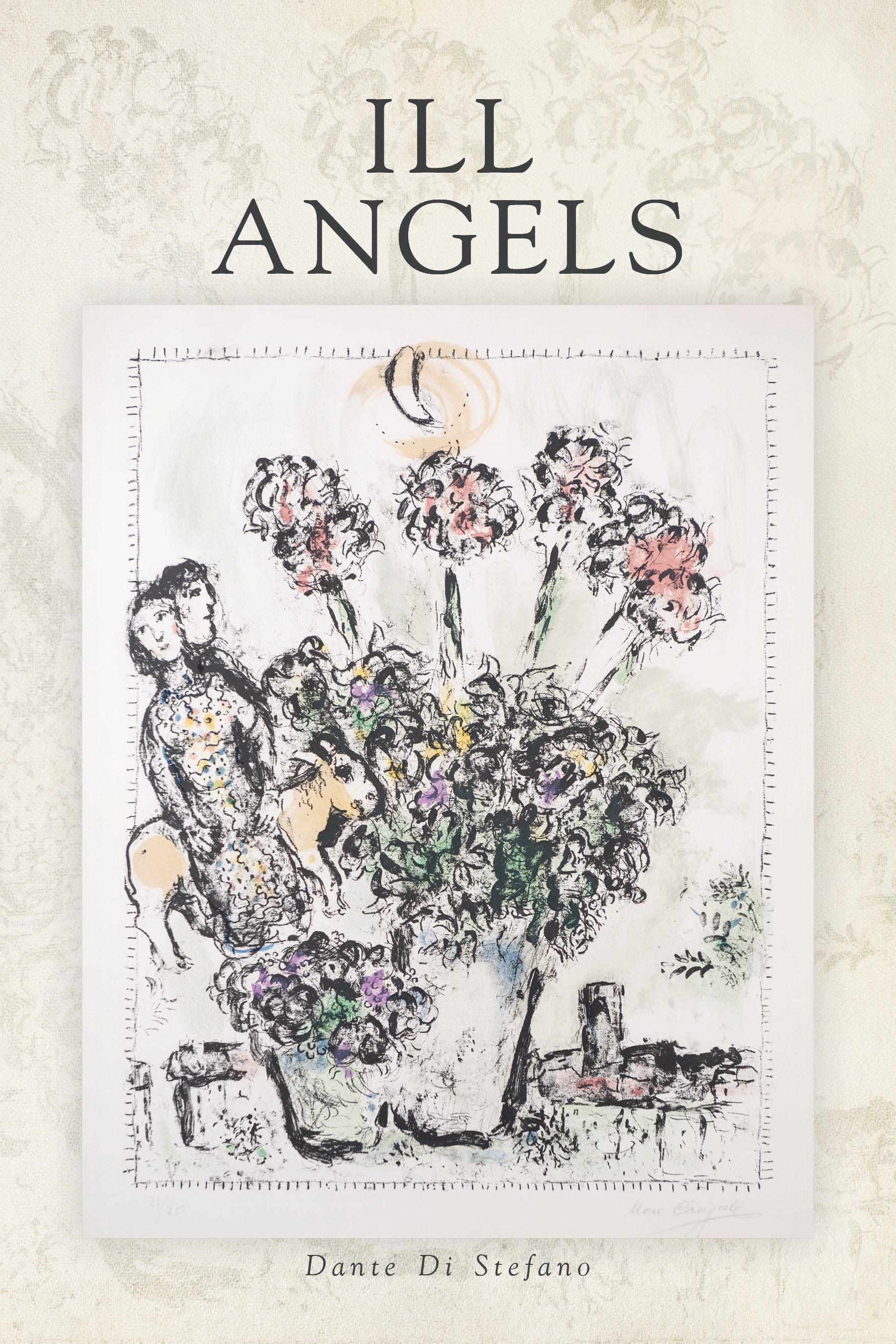
We are proud to welcome Dante Di Stefano’s Ill Angels to the Etruscan Press Family.
Ill Angels offers up the endless sacred consolations available to us through the restorative power of written and spoken words.
Ill Angels explores the cul-de-sacs and jubilees of early
midlife. In poems that are at once formally assured and daringly
inventive, Dante Di Stefano invokes the lives of artists, musicians, and
writers he admires as his poems ruminate on love, death, music,
language, and notions of national belonging.
|
|
|
|
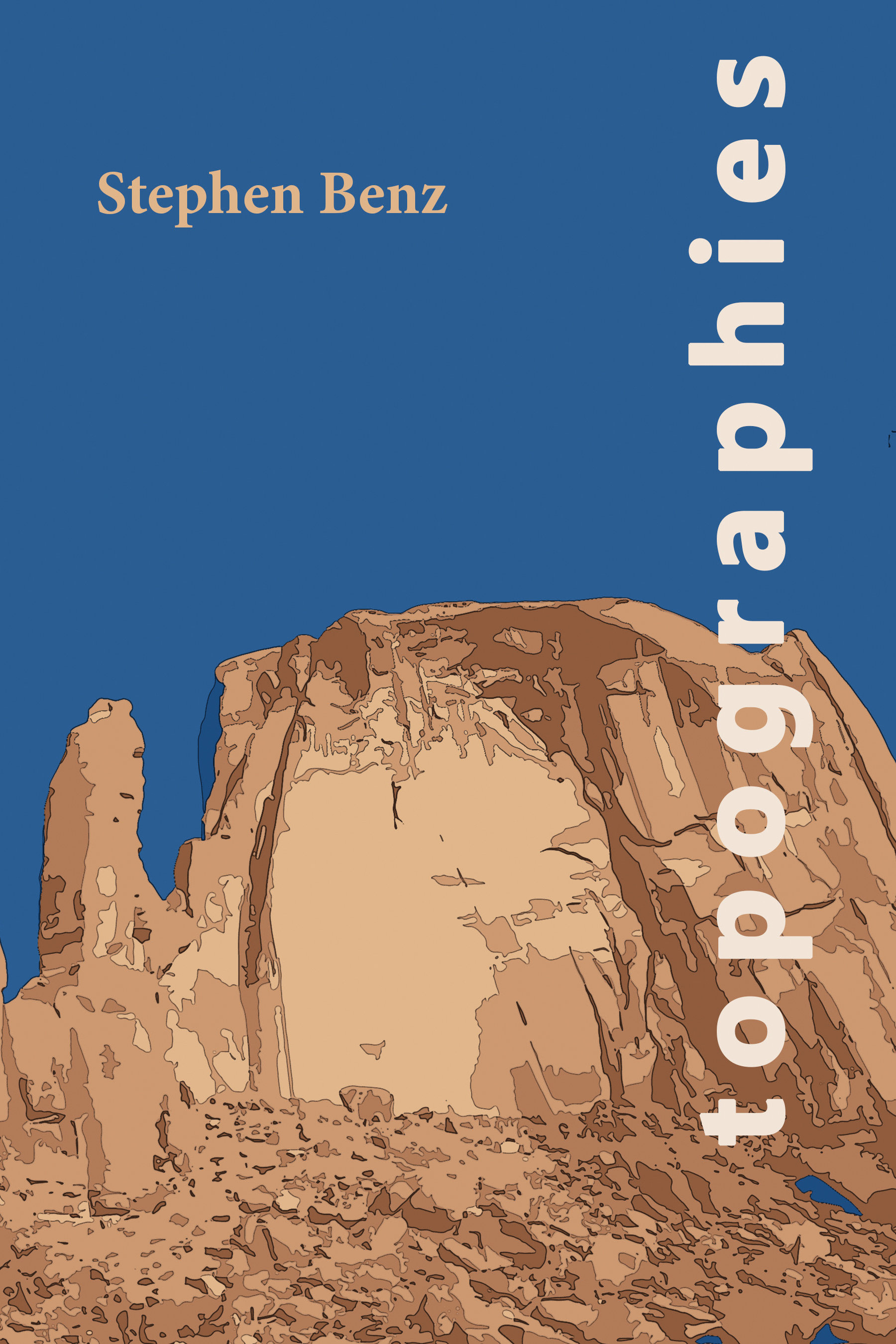
We are also excited to publish Topographies by Stephen Benz.
Topographies explores landscapes of historical and cultural
significance. Locations visited include the American West, Eastern
Europe, Florida, Cuba, and Central America.
A wild ride on the madcap streets of Guatemala City. A twilight walk
through old Havana with a Cuban mailman. A canoe trip in search of a
lost grave in the Everglades. A late-night visit to a border-town
casino. These are some of the experiences Stephen Benz describes in this
witty, insightful, and evocative collection of personal essays and
literary journalism. Benz takes readers to locales both familiar and
remote, introducing unusual characters and recounting little-known
historical anecdotes. Along the way, he contemplates the meaning of road
signs, describes the hardships of daily life in the former Soviet
Union, reflects on the lives and deaths of forgotten people, and listens
to a bolero during a Havana blackout.
|
|
|
|
2019 Etruscan Prize Awarded
|
|
|
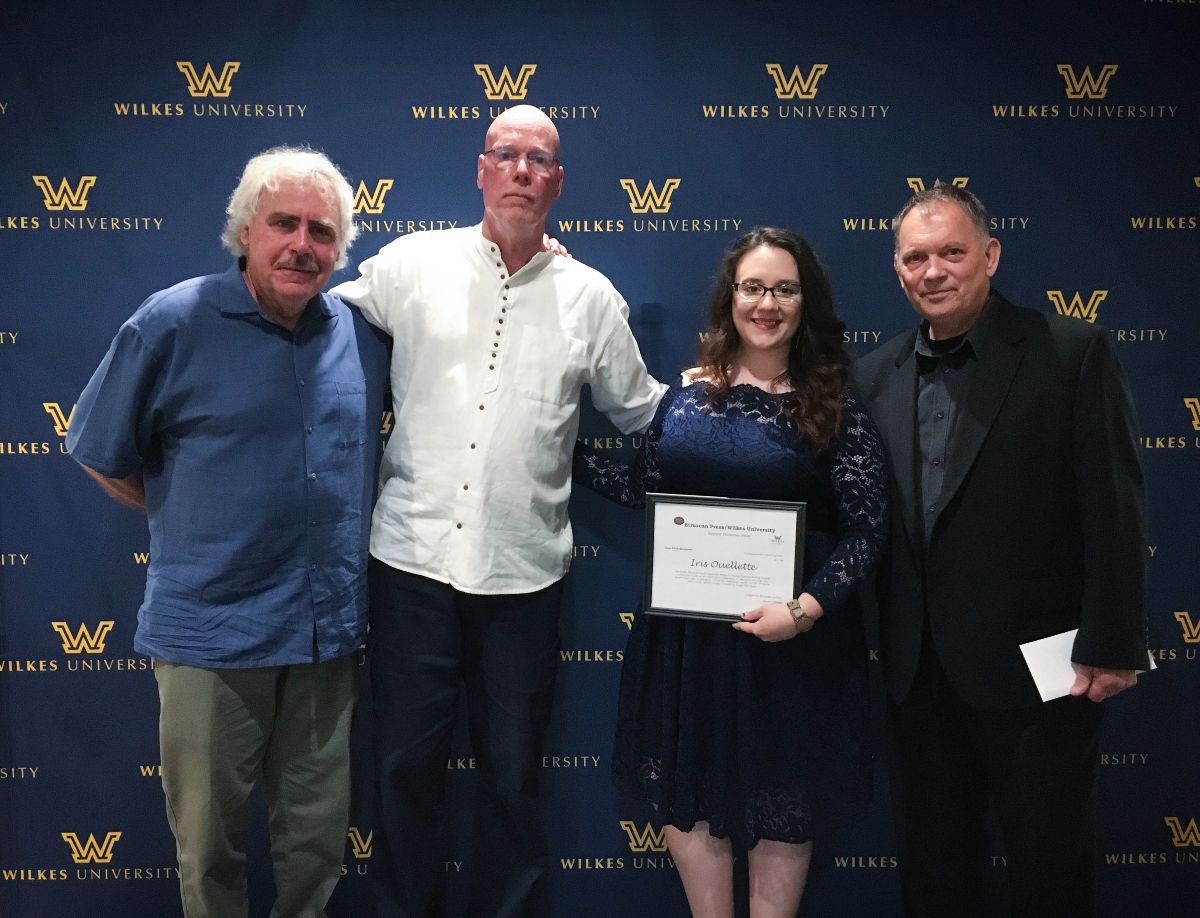
Etruscan
Press Executive Editor Robert Mooney; Etruscan Press Executive Director
Phil Brady; 2019 Etruscan Prize recipient Iris Ouelette of Pittston,
Pa.; and Etruscan Press Managing Editor Bill Schneider at the June 21,
2019 Wilkes Graduate Creative Writing Program ceremony. (Photo credit:
Shawn Hatten)
|
|
Iris Ouellette of Pittston, Pa. was awarded the Etruscan Prize at the
Wilkes University Maslow Family Graduate Program in Creative Writing
closing banquet held on June 21, 2019. The Etruscan Prize is awarded
each year to a member of the Wilkes Creative Writing student community
who submits one page of any genre (prose, script, poetry or play) that
sings. This was the tenth consecutive year Etruscan Press awarded a
Wilkes University Creative Writing graduate student for their writing
excellence.
Ouellette’s submission, “Into the Acadian Sea,” was the prize winner.
This was the fourth year the Etruscan Prize was awarded for a work of
fiction. Prize recipients from prior years were awarded for works of
fiction, memoir, and poetry. Ouellette is pursuing her master of fine
arts in the Maslow Family Graduate Program in Creative Writing. Wilkes
University faculty member Lenore Hart has served as Ouellette’s mentor.
Etruscan author Renée D’Aoust judged the award. D’Aoust commented about
Ouellette’s submission: “Into the Acadian Sea” evokes haunting longings
for the sea and for love lost. The scene is palpably real, yet
emotionally mysterious. Grief-stricken worries of the human heart are
set against a stark, beautiful landscape. While the central character
waits for the return of one who does “business in great waters,” we, the readers, also wait, enchanted by this page, ready for more.
Author of Body of a Dancer (Etruscan Press, 2011), Foreword Reviews Book
of the Year finalist for autobiography and memoir, D’Aoust was trained
on scholarship as a dancer at Pacific Northwest Ballet and later at the
Martha Graham Center for Contemporary Dance. She has numerous
publications and awards to her credit, including a fellowship from the
National Endowment for the Arts Journalism Institute for Dance Criticism
at American Dance Festival, support from the Puffin Foundation, and
grants from the Idaho Commission on the Arts.
D’Aoust’s anthology publications include Reading Dance (Pantheon, 2008), edited by Robert Gottlieb, On Stage Alone (University Press of Florida, 2012), edited by Claudia Gitelman and Barbara Palfy, and Animal Companions, Animal Doctors, Animal People (Ontario
Veterinary College, 2012), edited by Hilde Weisert and Elizabeth Arnold
Stone. D’Aoust holds degrees from the University of Notre Dame and
Columbia University.
|
|
About Etruscan Press:
Housed at Wilkes University and partnering with Youngstown State
University, Etruscan is a non-profit literary press working to produce
and promote books that nurture the dialogue among genres, cultures, and
voices.
For the latest Etruscan events, please visit our website.
|
|
|
|
|
|
|
|
|