|
The
world of literary contests can be confusing, if not humbling,
intimidating even, particularly to a young writer encouraged by mentors
to submit their work to book-manuscript competitions that typically
receive hundreds of entries out of which one will be chosen, promoted,
and published, thereby raising a writer from relative obscurity into
some measure of visibility, depending on the prize. The odds against any
one submission winning are so formidable and the process of literary
judgement and evaluative conversation so shrouded in mystery and rumor,
many younger writers find themselves spending fortunes only to give up,
losing faith in either their work or the perceived politics of
assessment. I recall my first book won a prize that a famous poet
blurbed in hyperbolic terms, though she said to me in private,
“Congratulations, thus you drop another feather in the Grand Canyon.”
Indeed, I had done precisely that, but then, I was not sure I wanted a
lot of people to read my book. Perhaps my endorser thought I needed a
little help maintaining perspective, or maybe I heard her sigh a bit of
self-lamentation. Doubtless the winning of a contest can feel
liberating, validating, if not exonerating, and well worth the money
spent on submission fees, if one has the means and a “worthy”
manuscript. But I had doubts about the worthiness of my work. If the
prize blew a little wind in my sails, it likewise urged me to do better.
It whispered, “Keep going.” And I did.
Perhaps the greatest sensation for any writer is receiving some evidence
that your work has actually been read and, better yet, slowly, closely.
Sometimes the smallest evidence is enough for us to carry on. What this
articulates about human nature is two things: we are all fundamentally
lonely and scared — scared of death, of course, but perhaps even to a
larger degree, the absence of meaning, value, and connection. Did I
mention my prize was minor? It was. I must have left that out for a
reason. I have won other more visible book contests since then that
indeed have eased the burden of creative solitude. And yes, creativity
tends to be haunted with narcissism — I call my writing “mine” after all
— but when a writer does her best work, she might experience a
different sort of “death,” a clarification of concerns, and sense of the
poet, as Keats claimed, as a “no one,” or rather a little of all, a
“chameleon” bearing the colors of its context. The “work” of art owes
its power to the embodiment of priorities. Every decision a poet makes —
every line break, figure, register of diction, speed of syntax,
phrasing, point of view, you name it — says something about what that
poet values, what contributes to the sense of the necessary, the sense
of a poem’s calling. When an artist is working so closely with the
medium, so intuitively, attentively, musically, viscerally, playfully,
paradoxically, rebelliously, and yes, even intellectually, with the
three dimensionality of multiple resonances of meaning and tone, when an
artist is embedded in the process of unfolding words in ways that defy
paraphrase and judgement, we have ventured far from the concerns of the
careerist and the literary contestant. We are inviting body, mind,
and heart all into the same room where they lose track of just who is
who. The irony remains that such focus can lead, if we are lucky, to a
career, an identity, a prize.
This is not to say, however, that we are any less an artist if concerns
about a reader’s judgement inflect our process. Quite the opposite. Such
concerns are endemic to the medium of language, which is both private
and public, for the simple reason that it is made up of relationships —
both dynamic and individual and, conversely, cultural and historical.
Moreover, words mark the place where the tension between the individual
and the collective becomes most heated, beautiful, and problematic. It
is not productive for a writer to deny any reality, let alone those
associated with ego. I find it far more useful to approach the ego as a
drive rather than a construct. In this way, it resembles a sex drive
insofar as it creates illusions but does not constitute one. It comes
and goes as a part of our nature. I tell my students that it is
unrealistic for them to simply “check their egos at the door.” The trick
is to have your ego work for you and not against you. In a pedagogical
context, I am thinking about the non-productive features of attachment
and a fear of influence and change. But the ego participates in creative
life quite productively in other ways. I have no problem with the idea
of self-interest haunting elements of gift-giving and communal literary
participation. A little shadow ghosts everything we do. What is the
purist if not the greatest narcissist of all? So, in our work, if we
want it to function in the world, to truly “work” out there, there comes
a time when our poems must leave home. They must find their way, on
their own terms, without our bodies in the room. For the most part,
contests are judged anonymously, and that practice has a beauty about
it. It suggests attention has a better chance of falling deeply into the
text, into the authority of feeling and idea born of one word following
another.
But there are myriad sensibilities that defer to an authority so broadly
defined. Doubtless the phrase “worthy manuscript” can conjure anxieties
about both the power of a work and the work of power. The “power out
there” that reads and judges us is, of course, an imaginary construct,
but somewhat inevitable, if not necessary, for the working writer to
consider. The first task, in sending out a manuscript to a particular
press or editor is to do a little homework, to read poems by those who
might be judging a book. The poems of general editors, screeners, or
final judges are, if available, the best indicators of what a press most
likely values. My best advice to young writers is to cultivate a
community based on what it is you love, what challenges you, what makes
you want to write. Send a writer an email of appreciation if you read
something you admire. Do not concern yourself with who is deemed
important or not by someone else. You are on the long path. Find
the writers and editors you respect. Send them your work. Send work to
contests judged by your favorite writers. Do not worry about emulating
the work of those who win prizes, unless their prizes mean nothing to
the quality of your attention and affection. Forge a trustworthy
bridge between your private work and your public aspirations. The
lasting and most valuable relationships in your career evolve through a
mutual exchange built on respect and a sense of shared adventure, the
sense of a language so deeply embedded in the seer and the seen none can
find its beginning or end.
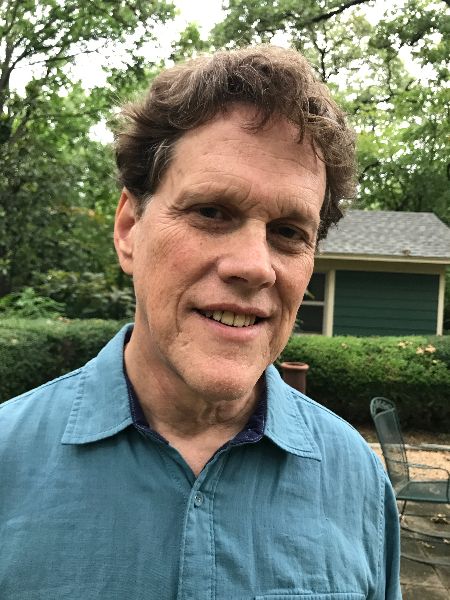
Bruce Bond is the author of twenty-seven books including, most recently, Blackout Starlight: New and Selected Poems 1997-2015 (L.E. Phillabaum Award, LSU, 2017), Rise and Fall of the Lesser Sun Gods (Elixir Book Prize, Elixir Press, 2018), Dear Reader (Free Verse Editions, 2018), Frankenstein’s Children (Lost Horse, 2018), Plurality and the Poetics of Self (Palgrave, 2019), Words Written Against the Walls of the City (LSU, 2019), and The Calling (Parlor, 2020). Presently he is a Regents Professor of English at the University of North Texas.
|