|
|
|
|
Etruscan Press Outreach Program Update
by Cynthia Kolanowski
|
|
|
One
afternoon this past June, I visited with graphic designer and
printmaker Christine Medley at her studio (“The Workshop”) in Scranton,
Pennsylvania. Etruscan had commissioned Christine to create letterpress
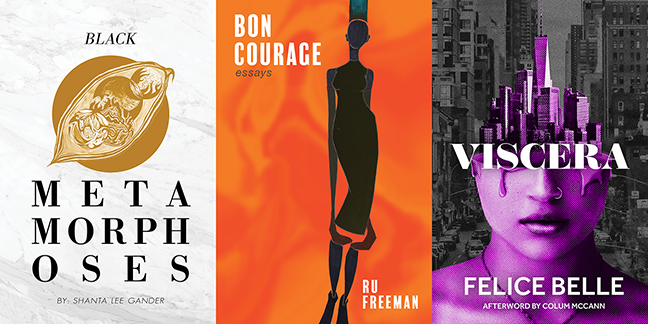
broadsides for three forthcoming titles: Shanta Lee Gander's Black Metamorphoses, Ru Freeman’s Bon Courage, and Felice Belle’s Viscera.
The broadsides were part of Etruscan’s preparations for LitFest, the
Maslow Family Graduate Program in Creative Writing’s celebration of
literature that takes place in June on the Wilkes University Campus.
This year's event was featuring Etruscan authors for its inaugural
Juneteenth celebration of Black writers and their featured readings
later in the week. The aforementioned authors are all new to Etruscan
and to the Wilkes community. To welcome and thank them for reading, we
wanted to provide them with broadsides that would be available for
purchase, especially for those writers whose books had not yet been
released.
I walked around Christine’s studio, admiring the lockups: the plate of one of Alan Blackwell's illustrations for Black Metamorphoses; the typefaces for Bon Courage (“My name is not my name” eclipsed by the power of the R and U in Ruthless); the purples of the Viscera cover bleeding down to Felice’s gorgeous last line, “Let the destruction be intentional.”
It was a lovely visit. And since then, I have been to Christine’s studio
again and again, to see her work on the broadside we commissioned for
J. Michael Lennon's new book (Mailer's Last Days); to meet
other local artists who sell their work in her studio; or just to say
hello and be surprised by receiving some fresh tomatoes from her garden.
The beginning of a friendship steeped in the arts.
I am reminded of what Wayne Benson wrote in the Etruscan Winter 2022
newsletter: publishers have a “responsibility to cultivate community.”
That’s been my mindset during my first few months as Community Outreach
Coordinator for Etruscan Press, for outreach is about making sure that
books don’t stop upon their publication. It's about finding and creating
opportunities to invite people into conversations about our books. It's
about helping them to see themselves in the literature we publish. It's
about creating and holding spaces where readers and writers may
(through workshops, readings, book signings, or social events) open
themselves up to our poems, essays, and stories, and in turn, feel
inspired to tell their own.
I want to show people in our communities that our books may bring
meaning, beauty, and value into their lives, and that we will value
their own stories in turn. This takes time, of course. It’s slow,
meaningful work. And it’s not the responsibility of any one person.
Here is a secret: community outreach doesn’t just provide our readers with a sense of community. It works for us, too.
When we sponsor a poetry festival, when our authors give readings, when
we put on an event or schedule a workshop—we find ourselves suddenly
surrounded by a sense of belonging, of community—an
atmosphere of like-minded literature-lovers, poets, and writers to which
we are contributing and from which we are benefiting. Whether listening
to our authors read, standing behind a table of Etruscan books, under
an umbrella at a festival, or selling books in downtown Wilkes-Barre, we
have come out from our home offices or from behind our desks at Harold
Cox Hall and are suddenly engaged with others. We are meeting our
readers face to face, just as they are delighting in the experience of
meeting our authors, the ones who write such beautiful books. And just
as they can hold our books in their hands and quietly flip through the
pages, we can enjoy the experience of meeting our readers, chatting with
them about what our books are about, how they came into being, and what
our own reactions to them have been.
One of my favorite moments was when, on one of the hottest days of the
summer, Production Editor Pamela Turchin and I put on a book sale on the
porch of Harold Cox Hall on River Street in Wilkes-Barre. We set up two
book displays as well as a cashier’s table with cold lemonade at the
ready. We had enjoyed a few visitors from the university, and from the
Wilkes-Barre community, when I spied my mother riding her red 1970
Schwinn down River Street from her home in Kingston. A book lover
herself, she happily perused a few books, enjoyed some lemonade, visited
with us for a while, then left after purchasing several Etruscan
titles. A few weeks later she called me wanting to discuss Will Dowd’s Areas of Fog—a
book she’s fallen in love with and since recommended to friends. We
didn't empty our supply that day, but we did sell books, and more
importantly, we engaged with our (Wilkes University and Wilkes-Barre)
communities. We made ourselves known.
For we have to start with that—letting people know we exist, on the
Wilkes campus, in the city of Wilkes-Barre, and elsewhere, getting the
word out that we produce stunningly beautiful books.
Since the book sale, we’ve had readings in Bryant Park and at the New
York City Poetry Festival. We’re planning for booths at Lit Youngstown
and the Downtown Wilkes-Barre Holiday Market, and we’re launching a
series of online writing workshops. We’ve been gathering with other
local nonprofits to discuss ways to collaborate and share resources, and
we’re working on grants and fundraising initiatives to ensure we have
the resources to cultivate community.
The mission of the Etruscan Outreach Program has not changed. Since
2007, we’ve fostered community engagement in reading and literature by
sharing the experience of writing with community members, encouraging a
love of literature across multiple demographics, and increasing cultural
and literary awareness. We hope you’ll support our efforts: check out
the Events Calendar on our website and attend one of our author readings
or help promote these events on social media. If you teach, invite one
of our authors into your classroom and use the resources from our
virtual library. Most importantly, share our books with friends and help
us nurture a colloquy of voices: writers and readers engaged in
enlivening the discourse between individuals and across communities.
For now, I look forward to continuing conversations with Etruscan
authors, making friends in the arts, planning for events, and thinking
more about this shared responsibility of cultivating community. I hope
to see you soon—in person or online—at a future Etruscan event.
|
|
New Release from Etruscan
|
|
|
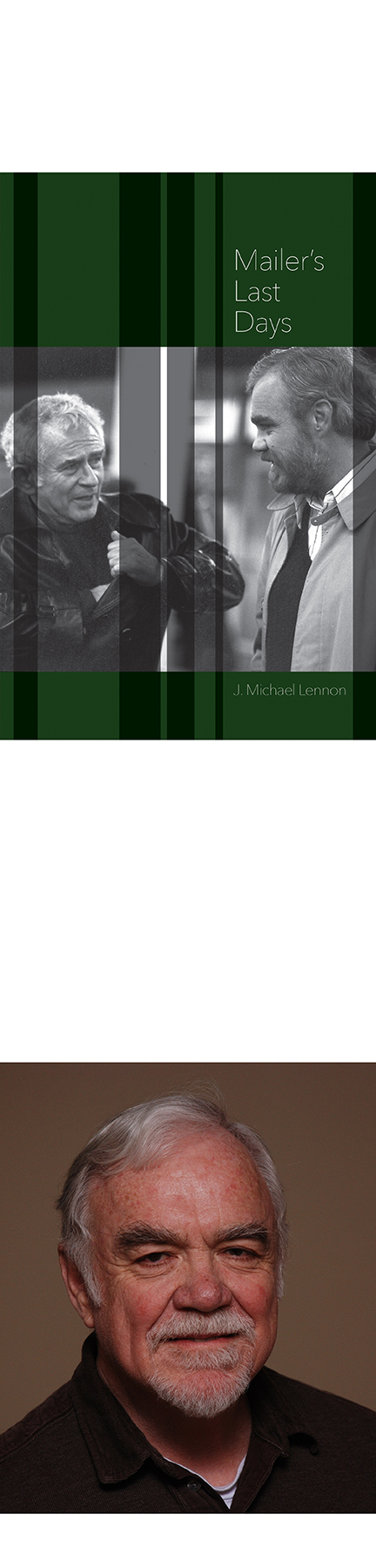
We are pleased to welcome Dr. J. Michael Lennon’s Mailer’s Last Days: New and Selected Remembrances of a Life in Literature to the Etruscan Press collection.
Through the rising action of his life in literature, Lennon tracks the
influence of his literary pater familias, Norman Mailer, as well as that
of his actual father, and how together these mentors focused the 20/20
vision Lennon takes to the work of Mailer and contemporaries ranging
from Muhammad Ali and Don DeLillo to James Baldwin and Joan Didion. This
collection combines eight unpublished essays about Lennon’s life with
twenty-one previously published essays and reviews, as well as two
interviews with Mailer—one unpublished—and excerpts from Lennon’s
unpublished journal of Mailer’s final years.
Lennon is Mailer’s authorized biographer, Chair of the Editorial Board
at Mailer Review, and Emeritus Professor of English at Wilkes
University. He teaches in the Wilkes Maslow Family Graduate Creative
Writing Program, which he co-founded in 2005. He is author or editor of
several books about Mailer, including Norman Mailer: A Double Life (2013), Selected Letters of Norman Mailer (2014), and On God: An Uncommon Conversation (2007, co-authored with Mailer).
|
|
|
Mildred Mills of Atlanta, Ga. was awarded the Etruscan Prize for
“Daddy’s House: A Place to Run Away From,” in June during the
Wilkes University Maslow Family Graduate Creative Writing Program
residency. In its thirteenth year, the Etruscan Prize is awarded
annually to a Wilkes Creative Writing student who submits one page of
any genre (prose, script, poetry, or play) that sings.
“‘Daddy’s House’ is a prose piece that emerges from the same wellspring
that has given us the blues and traditional country music,” said
Etruscan author Stephen Benz, who judged the award. “And these rich
paragraphs, too, thrum with music, the music intrinsic to the piece’s
down-home rural setting. There’s music in the birds, the bees, the soil,
the blossoms, the cotton fields, the farmyard, and the cinderblock home
that the writer skillfully describes for us. Most of all, there’s music
in the language that the writer uses to convey the scene and to express
the deepest yearnings of the soul.”
“As in traditional American music, it is a language that is at once
plain spoken and lyrical. And like the best blues or country songs, just
when we think we know where things stand, there’s a sudden reversal,”
Benz continued. “The gentle nostalgia that begins the piece yields to a
more complicated questioning of the meaning of home. The compelling
voice that we hear in ‘Daddy’s House’ sings to us of joy and
frustration, comfort and confusion, beauty and grit. It is a voice that
we listen to with fascination, eager to hear more.”
Mills is pursuing her Master of Arts in Creative Nonfiction in the
Maslow Family Graduate Program in Creative Writing. Wilkes University
faculty member Beverly Donofrio has served as Mills’ mentor.
Benz has published four books of creative nonfiction, including Topographies and Reading the Signs: and other itinerant essays (both from Etruscan Press). He has also published a book of poems, Americana Motel (Main Street Rag Publishing Co.), along with essays in New England Review, Creative Nonfiction, River Teeth, and Best American Travel Writing. He lives in Albuquerque, where he teaches at the University of New Mexico. Website: www.stephenconnelybenz.com.
It was the fifth year the Etruscan Prize was awarded for a work of
creative nonfiction. Prize recipients from prior years were awarded for
works of fiction, memoir, and poetry.
|
|
About Etruscan Press:
Housed at Wilkes University and partnering with Youngstown State
University, Etruscan is a non-profit literary press working to produce
and promote books that nurture the dialogue among genres, cultures, and
voices.
For the latest Etruscan events, please visit our website.
|
|
|
|
|
|
|
|
|