|
A
few weeks ago, I was part of a Hamilton College alumnae poetry reading,
and after the reading a woman asked a simple question: “How do you
write a poem?” I didn’t have an answer, so I suggested a few books by
poets like John Hollander, Mary Oliver, and Billy Collins. The woman
shook her head and said she had read books like that, but they didn’t
help. She wanted something else, like a genuine operating manual—a step
by step explanation.
I, too, love instruction manuals, especially those manuals on how to
perform magic: write a poem or know God or make love, if only love were
something that could be made. Manuals offer such promise. Yes, you, too, can enter the bee-loud glade and the Promised Land and have an orgasm.
I love the idea that my mind could be programmed like a computer to spit
out poems on demand—poems with just the right number of lines,
syllables, metaphors, meanings, similes, images . . . And with no
clichés, no matter how much I love those Tom, Dick and Harry’s with
their lovely wives, as fresh as daisies. I can set them in any novel or
town in America, and they will have sex twice a week, always before ten
at night, never at the eleventh hour, and it will not take long, time
being of the essence.
I love sex manuals, too: those books that suggest our bodies are like
cars. If only we could learn to drive them properly, bliss would be a
simple matter of inserting a key, mastering the steering wheel,
signaling our next moves, knowing the difference between the brakes and
the gas pedal, and of course, following the speed limit.
A depressive person by nature, I am also a fan of how-to books on God,
faith, happiness, the soul, books that suggest a divine presence is
always here. I just need to find it, or wake up to it, or turn off my
doubting brain. That even now, my soul is like a bird in a cage. If I
could sit still long enough and listen closely, it might rest on my open
palm and sing me a song.
God, poetry, sex, they offer brief moments of bliss, glimpses of the
ineffable, and occasional insights into that which does not translate
easily into daily experience, or loses its magic when explained.
In college, I took classes in religion, philosophy and poetry, and I
studied sex in my spare time—my first roommate and I staying up late,
pondering the pages of The Joy of Sex. As a freshman, I
auditioned my way into an advanced poetry writing class by composing the
single decent poem I wrote in my college years. The poem, an ode to
cottage cheese, came to me in a flash as a vision nestled on a crisp bed
of iceberg lettuce. Does cottage cheese nestle? I don’t know, but the
professor kept admiring that poem. He said all my other poems paled by
comparison.
This was in the era of the sexual revolution, long before political
correctness and the Me-Too movement. My roommate, obsessed with getting
laid, said we women should have been given a compass to navigate the
sexual landscape. She liked to complain that she’d had only one orgasm
in her entire life, and she wanted another. “What if I am a one-orgasm
wonder?” she worried. The subject of orgasms kept us awake, night after
night.
In religion class, my professor told the famous story about Blaise
Pascal who had a vision of God that was so profound his life seemed
dull and meaningless forever afterwards. He never had another vision.
But he had sewn into his jacket an incoherent note to remind him of the
singular luminous experience.
The next day in religion class, a student stood up and announced that
the professor was wrong—about Pascal, God, everything. The student knew
this because he was God’s friend. He even knew His first name, and what
God was thinking. The professor smiled sadly, put his arm around the
student, and led him out of the classroom, down the steps and into the
counselor’s office. When the professor returned, he warned us that if we
ever thought we knew God, we should check ourselves into a mental
institution. Lots of insane people know God intimately.
But, I wondered, what would God (or the transcendent—or whatever word
you might choose for it: the muse, love, the orgasm, the soul, the
higher self) think of us?
For example, what would a muse think of a writer trying, begging,
praying to enter the creative flow? All writers know it—that moment when
inspiration happens. The incredible high. And the opposite, when words
cling to the wall of the mind like sticky notes but never make it onto
your tongue or the page.
What would an orgasm think of all the people seeking it so fervently yet
considering it dirty, embarrassing, unmentionable? And then lying about
it. “Did you have one?” a man might ask. “Yes,” his lover nods. But
every orgasm knows it cannot be had. Or possessed. Or sewn into the
lining of a coat. No one “has” an orgasm. At least not for long.
What did God think of Martin Luther, calling out to him in terror when a
lightning bolt struck near his horse, “Help! I’ll become a monk!” And
later, when he sought relief from his chronic constipation and gave
birth to the Protestant Reformation on the lavatory—a lavatory you can
visit today in Wittenberg, Germany.
I don’t want to evaluate Luther’s source of inspiration. But I do want
to ponder the question: How do you write a poem? Is there a way to
begin?
I think John Ashbery gave away one secret in his poem, “The Instruction
Manual:” that it begins with daydreaming. Imagination. And the
revelation that the mind contains its own magical city, its own
Guadalajara, complete with a public square and bands and parading
couples that you can visit this enchanted town for a limited time before
you must turn your gaze back to the humdrum world.
But a student of Ashbery’s might cringe at the suggestion that poetry is
merely an act of the imagination. In order to master the dance, one
must know the steps. And Ashbery was a master. So many of his poems
follow a kind of Hegelian progression, traveling from the concrete to
the abstract to the absolute. Or what Fichte described as a dialectical
movement from thesis to antithesis to synthesis. Fichte also wrote that consciousness itself has no basis in reality. I wonder if Ashbery would have agreed.
In college I wrote an inane paper, comparing Ashbery’s poetry to a form
of philosophical gardening in which the poet arranges the concrete,
meaning the plants or words, in such an appealing order that they create
the abstract, or the beauty, desired. Thus, the reader experiences the
absolute, or a sense of wonder at the creation as the whole thing sways
in the wind of her mind.
Is there a basis in reality for wonder? Or poetry? I asked. Or are we
only admiring illusions, the beautiful illusions the poet has
created? How I loved questions like that. I wanted to follow in
the footsteps of Fichte and Hegel and Ashbery and write mystical and
incomprehensible books. I complained to my mother that no matter how
hard I tried, I could not compose an actual poem or philosophical
treatise—I was trying to write treatises, too. “That’s good,” she said.
“Poets and philosophers are too much in their heads, and not enough in
the world.”
I didn’t argue with her and tell her that not all poets are like Emily
Dickinson. Or say that Socrates was put to death for being too much in
the world, for angering the public with his Socratic method of
challenging social mores, and earning himself the title, “the gadfly of
Athens.”
Instead, I thought, That’s it! If I want to be a poet, I just need
to separate my head from the world. Or at least turn off the noise of
the world. And seek solitude, as Wordsworth suggested, in order to
recollect in tranquility. I imagined myself going on a retreat or
living in a cave, studying the shadows on the wall. Letting them speak
to me or seduce me or dance with me.
The shadows, I discovered, are not nice guests. Sometimes they kept me
awake all night, talking loudly, making rude comments, using all the
words I never said aloud. “Hush,” I told them. “No one wants to hear
that.” Sometimes they took on the voices of the dead and complained I
hadn’t told their stories yet or right. Sometimes they sulked and bossed
me about like a maid, asking for a cup of tea, a biscuit, a little
brandy, a nap. One nap was never enough. When I obeyed and closed my
eyes, they recited the poems I wanted to write down. “You can’t open
your eyes until we’re done,” they said, as if poetry were a game of
memory, or hide and seek in the mind. Other times they wandered away and
down the dirt road of my past, or lay down in the orchard and counted
the peaches overhead. Whatever they did or said, I watched and listened.
That’s how I began writing my first real poems. I knew not to disobey
the shadows. I knew not to turn my back on them and look towards the
light as Plato suggested—Plato who wanted to banish the poets and poetry
from his Republic. I knew to not answer the door if the man from
Porlock came knocking.
To this day I am grateful for the darkness. For the shadows it creates
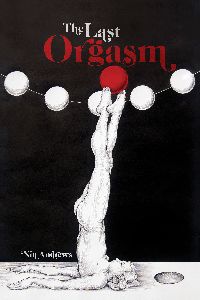
in my mind. It is thanks to them I have written another book, The Last Orgasm,
a book whose title might make people cringe. But isn’t that what
shadows do? And much of poetry, too? Dwell on topics we are afraid to
look at in the light?
Nin Andrews’ poems have appeared in many literary journals and anthologies including Ploughshares, Agni, The Paris Review, and four editions of Best American Poetry.
The author of six chapbooks and seven full-length poetry collections,
she has won two Ohio individual artist grants, the Pearl Chapbook
Contest, the Kent State University chapbook contest, the Gerald Cable
Poetry Award, and the Ohioana Prize for Poetry. She is also the
editor of a book of translations of the Belgian poet, Henri
Michaux, Someone Wants to Steal My Name. She lives on a farm in Charlottesville, Virginia with her husband, cows, coyotes, and many bears.
|